AI-generated ads dropped the ball at this year’s Super Bowl
Not a single one of these commercials made betting on gen AI seem like a good idea.
Not a single one of these commercials made betting on gen AI seem like a good idea.
It feels like everyone who produced ad spots for this year’s Super Bowl with generative AI failed in terms of making gen AI seem useful or like something worth getting excited about. Though we’ve seen plenty of AI-generated commercials before (at previous Super Bowls, no less), this year’s event was oversaturated with them. That’s in part because image and video generation models have become more sophisticated in the past year — though still subpar compared to what humans create, they’re just improved enough for a number of brands to now be comfortable having their names associated with AI-derived footage.
Also, it’s much, much cheaper and faster to use gen AI, which is convenient when the cost for 30-second ad spots at this year’s Super Bowl ranged anywhere from $8–$10 million. With traditionally produced ads from previous Super Bowls, you could really see how spending money on production ultimately led to commercials that felt more premium than what you would usually see on television. But this year, there was an undeniable cheap and sloppy quality to many of the advertisements. Here are some of them.
One of the worst examples of this was the Artlist ad. The main thrust of the ad (which only aired in New York and Los Angeles) from Israeli creative firm Artlist is that anyone can generate Super Bowl-worthy video footage using the company’s suite of production tools. It even makes a point of bragging that Artlist only bought its Super Bowl space about a week ago and spent a mere five days producing the commercial. That would be impressive if Artlist’s final product actually looked like something that would get average consumers to want to use these tools.
Instead, the ad features the very hallmarks that have convinced people to see AI-generated video as slop. Rather than telling a short, compelling, cohesive story of any kind, the ad is just a series of very short clips of animals doing weird things, strung together with a voice-over. There is nothing innovative about it. And given how much slop there already is in the world, the whole thing feels more like a threat than a promise of good things to come.
For its presence at the Super Bowl, vodka brand Svedka — which is owned by Sazerac Company — resurrected its old Fembot CGI character, gave her a new male-presenting companion called Brobot, and dropped the android pair into a commercial that was almost entirely created with gen AI. Though Fembot has previously been part of the larger Svedka brand and has always looked… like that, everything about the Brobot character feels like a ripoff of I, Robot’s Sonny character, who was portrayed by Alan Tudyk in the 2004 film.
Speaking to The Hollywood Reporter ahead of the Super Bowl, Sazerac’s chief marketing officer, Sara Saunders, said that using AI to create the ad didn’t actually save the company all that much time or money. Rather, Sazerac felt that an AI aesthetic could be thematically resonant for a vodka brand, and the company believed that the ad could convey a message that “is ultimately pro-human.”
The ad’s story is pretty straightforward: Two robots show up at a club, pop bottles of vodka out of their bodies, and proceed to get drunk while standing in a crowd of awkwardly dancing, AI-generated humans. We’re meant to understand that liquor helps machines let loose in a very human way. But what stands out most about the commercial is the way Brobot starts short-circuiting after gulping down a drink, which immediately starts spilling down its chassis because the machine’s mouth isn’t connected to an internal system of pipes that are meant to process fluids.
Though Sazerac says Brobot’s malfunction is intentional, it looks very much like the sort of gross accidental video output that AI models have been known to generate without being explicitly prompted to do so. The sequence reads like the Brobot character is breaking itself by interacting with Svedka’s product, which isn’t exactly the sort of message that alcohol companies have been known to lean into. Sazerac can try all it wants to spin the Svedka ad as a win that’s in line with the vodka brand’s identity, but the most pro-human thing the company could have done in this situation would have been to hire more humans to develop a better idea.
Clearly, we’re not alone in our feelings about gen AI’s less-than-polished production process, which is why it was even riskier for these brands to participate in it this year. So much animosity is in the air that people are now quick to assume that wonky visuals are AI-generated, even if sloppy editing work might actually be to blame.
One of the most star-studded Super Bowl commercials was a Jurassic Park-themed ad for Comcast’s Xfinity network that digitally de-aged Sam Neill, Laura Dern, and Jeff Goldblum. While people across social media have remarked that the questionable CGI and de-aging “look like AI slop,” Industrial Light & Magic (ILM) and Lola VFX are actually credited for creating the visual effects — the latter of which has been digitally de-aging actors for years in movies like X-Men: The Last Stand and The Curious Case of Benjamin Button.
Dunkin’s ad spot fell foul of the same speculation regarding AI usage. The “Good Will Dunkin’” commercial featured de-aged versions of Ben Affleck, Jennifer Aniston, Matt LeBlanc, and other stars parodying a ’90s sitcom, but the oddly smoothed skin and unnatural facial movements have divided opinions online regarding whether AI was used to shave three decades off the actors’ appearances. Sure, the ad has gone viral because people are playing “spot the AI Super Bowl ads,” but none of those conversations are about coffee or pastries.
There are usually some machine learning processes involved with creating computer-generated effects, but these are typically embedded with creative software editing tools rather than the text-to-video models now associated with AI videos. (We have reached out to Dunkin’, ILM, and Lola VFX to ask what tools were used to create the Xfinity and Dunkin’ ads.)
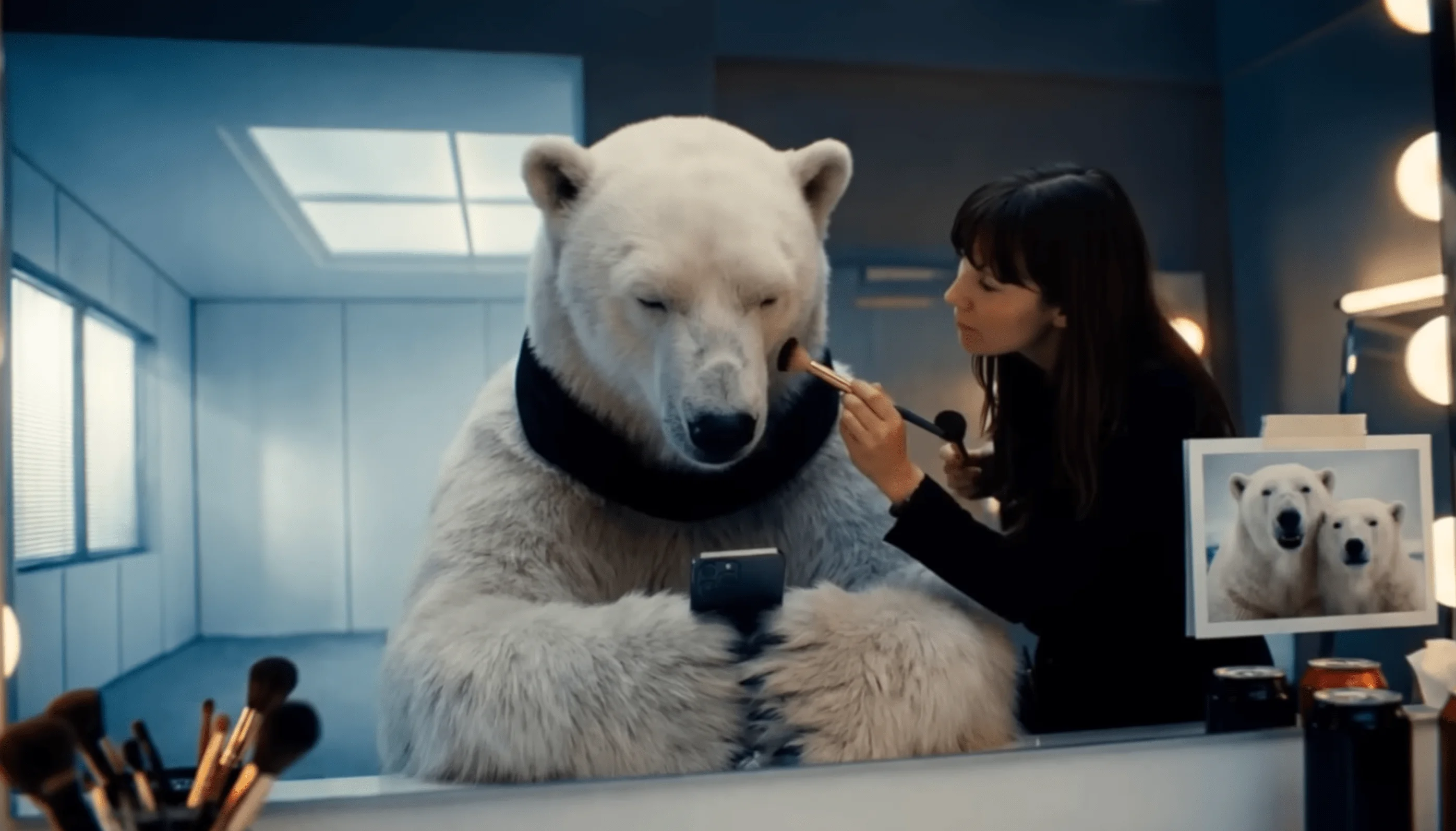
AI usage has also worked its way into rivalries between companies, as seen with the Super Bowl ad for Pepsi Zero Sugar. The commercial, set to Queen’s “I Want to Break Free,” features a CGI polar bear (traditionally a Coca-Cola mascot) having a crisis about preferring Pepsi in a blind taste test. It ends with the message that consumers “deserve taste” — possibly a jab at Coca-Cola’s controversial AI-generated holiday ads. In a statement to AdWeek, Pepsi marketing VP Gustavo Reyna said it was important to have a human touch in the ad. “If there’s something we care about and we believe in, it’s in the craft and the creativity of our people, our talent, and our partners,” Reyna said. Even if this is meant to be understood that unlike Coca-Cola, Pepsi is not using AI, it is suspicious by association on account of the “animals doing weird stuff” trope farmed so sloppily by Artlist.
This latest crop of gen AI ads was, in part, aiming to normalize the technology via onslaught. But the point of a truly effective Super Bowl ad is to create a cultural moment that is positive and exciting to associate with your product. Instead, the ads have left people questioning: Is it AI? Does it just look like AI? Does it even matter anymore?