Budapest-based Allonic, which is developing a new way to produce robotic bodies, has raised $7.2m in pre-seed funding, the largest ever round of its type in Hungary.
The round was led by Visionaries Club, with participation from Day One Capital, Prototype, SDAC Ventures, TinyVC and RoboStrategy. More than a dozen angel investors from OpenAI, Hugging Face, ETH Zurich and Northwestern University also invested.
Robotics is on a tear in Europe. Companies in the sector raised €1.6bn in equity funding last year, an increase of 130% on 2024, according to Sifted data. But while AI breakthroughs are transforming how robots operate, there are a number of constraints still holding the sector back, including how robot bodies are manufactured, something Allonic is looking to solve.
Today, most advanced robots are built through the slow, often manual assembly of hundreds of precision parts, with robotic hands, arms and manipulators still put together piece by piece, relying on bearings, screws, cables and delicate joints that are costly to manufacture and difficult to scale.
“A lot of people agree that where robotics is versus where it could get to is tremendously different,” says Marton Sarkadi Nagy, a partner at Visionaries Club.
“There have been a lot of investments into the data side, simulations, software, models and pre-training, but very often people forget hardware remains one of the most important bottlenecks in robotics,” he adds. “We won’t get there if the hardware is not right.”
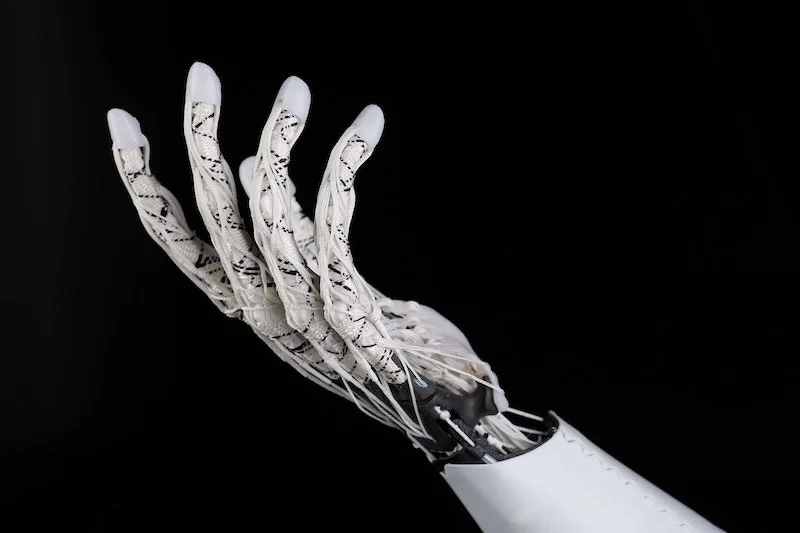
The production process developed by Allonic, known as 3D tissue braiding, replaces the manual process of putting robotics together with an automated manufacturing system. Instead of assembling hundreds of individual parts, Allonic’s system weaves together the robotic equivalent of tendons, joints and soft tissue in one continuous process on top of an endoskeleton.
“It’s inspired by how rope braiding works,” Benedek Tasi, Allonic’s cofounder & CEO, tells Sifted. “You have the ability to do anything with a high design freedom.”
The company is starting by focusing on manipulators — hands, grippers, various end-effectors — and hopes to move into arms and “maybe expand to the whole body” as its tech develops, Tasi says. It’s also not just focusing on humanoids, says Tasi, “but a wide range of form factors.”
Days to minutes
Tasi says Allonic will be able to bring down the time it takes to produce a finger or manipulator or an arm for a robot to a couple of minutes.
“What you get out from the machinery is basically a finished product that you will need to wire up to the actuators,” he says. “Instead of hours or days it should be a couple of minutes, with the production itself also taking a couple of minutes. We’re talking a magnitude of difference.
“Being able to go from idea to physical robot in minutes instead of weeks fundamentally changes how we can think about robotics design,” Tasi says. “Once that barrier disappears, entirely new classes of robots become possible.”
Allonic has already completed its first pilot project with a customer in electronics manufacturing. Tasi says in this area of the market — in between pick and place and industrial humanoids — there’s “already a much greater need for versatility than what current industrial solutions can provide.”
The company sees itself as an “infrastructure player”, where customers can use its platform to design their own custom robot bodies which are then delivered to them by Allonic. Longer-term, Tasi says it’s thinking of a business model where it sells the full platform to customers to use in house.
Its headcount is currently 15, but Tasi says he wants to use some of the funding round to grow the team to 25-30. It’ll also be used to develop its tech platform, and support further pilots and early commercial deployments with industrial partners.
“We’ve had a lot of conversations with potential pilot customers, startups, players in industry and humanoid space, big tech companies,” Tasi says.