
Despite talk of its impending demise, the vibe coding craze appears to be alive and well, particularly in Europe.
A new study by vibe marketing website LeadsNavi analyzed Google search data to identify which countries are searching for vibe coding the most. The research examined both total annual search volume and searches per 100,000 residents, offering insight into where curiosity and adoption are most concentrated globally.
Developers and non-tech users alike are looking at new ways to code more intuitively and are researching vibe coding via search engines.
According to the study, interest in the concept of vibe coding is growing steadily worldwide, with Europe leading global interest.
“This rise in search activity reflects broader shifts toward creative coding, AI-assisted development, and more expressive programming workflows,” the study says.
Across both high- and low-ranking countries, common search phrases include “vibe coding,” “how to use vibe coding,” “vibe coding tools, “Claude code,” “lovable,” and “bolt”.
“This mix suggests many users are still learning the concept, while others are actively exploring how to implement it in real-world projects,” the study authors surmise.
Switzerland, Germany, Sweden, and Finland all rank in the top five countries most interested in vibe coding, with outlier Canada coming in third. The bottom five countries consisted of Italy, Spain, Hungary, Slovakia, and Czechia.
Brad Shimmin, an analyst at the Futurum Group, explains the breakdown to the The New Stack this way:
“My first impression is that these countries must surely participate heavily in the global software engineering market,” Shimmin says. “But interestingly, the usual hotspots in Eastern Europe — Poland and Ukraine — don’t appear to be on their list. That aside, I would say that these numbers favor countries with strong labor laws such as Germany, which may indicate that agentic code generation has a greater impact where perceived job security is at its highest level, comparatively.”
The top 5
Switzerland ranks first overall with 41.19 vibe coding searches per 100,000 residents.
“Despite a relatively small population, it shows the highest intensity of interest, suggesting a strong concentration of developers and tech professionals engaging with new programming approaches,” the study says of Switzerland.
Germany ranks second with 40.29 searches per 100,000 residents and a total of 33,700 searches, with common queries including “how to use vibe coding.”
As stated, Canada comes in third with 37.78 searches per 100,000 residents. Canada’s searches appear to be more application-focused, the study shows. There was strong interest in “vibe coding tools,” suggesting users may already understand the concept and are looking to apply it.
Sweden and Finland rank fourth and fifth place, with 35.04 and 34.69 searches per 100,000 residents, respectively. This reinforces Northern Europe’s reputation for early adoption of developer-led trends and experimental coding practices, the study says.
The next five
Malta ranks sixth with just 190 total searches but a high per-capita figure of 34.61. France ranks seventh, with per-capita interest at 33.53 searches per 100,000 residents. Denmark and Luxembourg rank eighth and ninth, with 32.71 and 32.00 searches per 100,000 residents.
Meanwhile, Australia rounds out the top 10 with 31.22 searches per 100,000 residents, which makes it the highest-ranking country outside Europe and the strongest performer in the Asia-Pacific region, the study said.
Asia and the US
The study did not include Asian countries. “As the data were based on Google search volumes, we chose not to include Asian countries, as Google is not the primary search engine in many of those markets,” a spokesperson for LeadsNavi tells The New Stack.
Interestingly, the United States ranks 15th with 26.78 searches, just behind the United Kingdom at 26.93 and ahead of New Zealand at 25.53. This may indicate that the US is further advanced with vibe coding or is losing interest.
“From our data, it is US leading clearly – both from end users and SI engagement doing work for customers, and customers asking for it,” Holger Mueller, an analyst at Constellation Research, tells The New Stack.
Overall, the findings show that interest in vibe coding is strongest in smaller, highly tech-literate countries, particularly in Northern and Central Europe.
The Bottom Five
Regarding the bottom five, Czechia and Slovakia rank 20th and 21st with 18.90 and 16.69 searches per 100,000 residents, respectively. Italy places 22nd overall with 14.00 searches per 100,000 residents. Spain and Hungary tie for last with each recording 13.98 searches per 100,000 residents, despite both countries having active tech sectors.
Full list of countries using vibe coding the most:
| Rank | Country | Vibe coding searches per 100,000 residents |
| 1 | Switzerland | 41.19 |
| 2 | Germany | 40.29 |
| 3 | Canada | 37.78 |
| 4 | Sweden | 35.04 |
| 5 | Finland | 34.69 |
| 6 | Malta | 34.61 |
| 7 | France | 33.53 |
| 8 | Denmark | 32.71 |
| 9 | Luxembourg | 32.00 |
| 10 | Australia | 31.22 |
| 11 | Netherlands | 30.46 |
| 12 | Greece | 30.21 |
| 13 | Austria | 27.34 |
| 14 | United Kingdom | 26.93 |
| 15 | United States | 26.78 |
| 16 | New Zealand | 25.53 |
| 17 | Ireland | 25.20 |
| 18 | Portugal | 23.86 |
| 19 | Belgium | 21.06 |
| 20 | Czechia | 18.90 |
| 21 | Slovakia | 16.69 |
| 22 | Italy | 14.00 |
| 23 | Spain | 13.98 |
| 24 | Hungary | 13.98 |
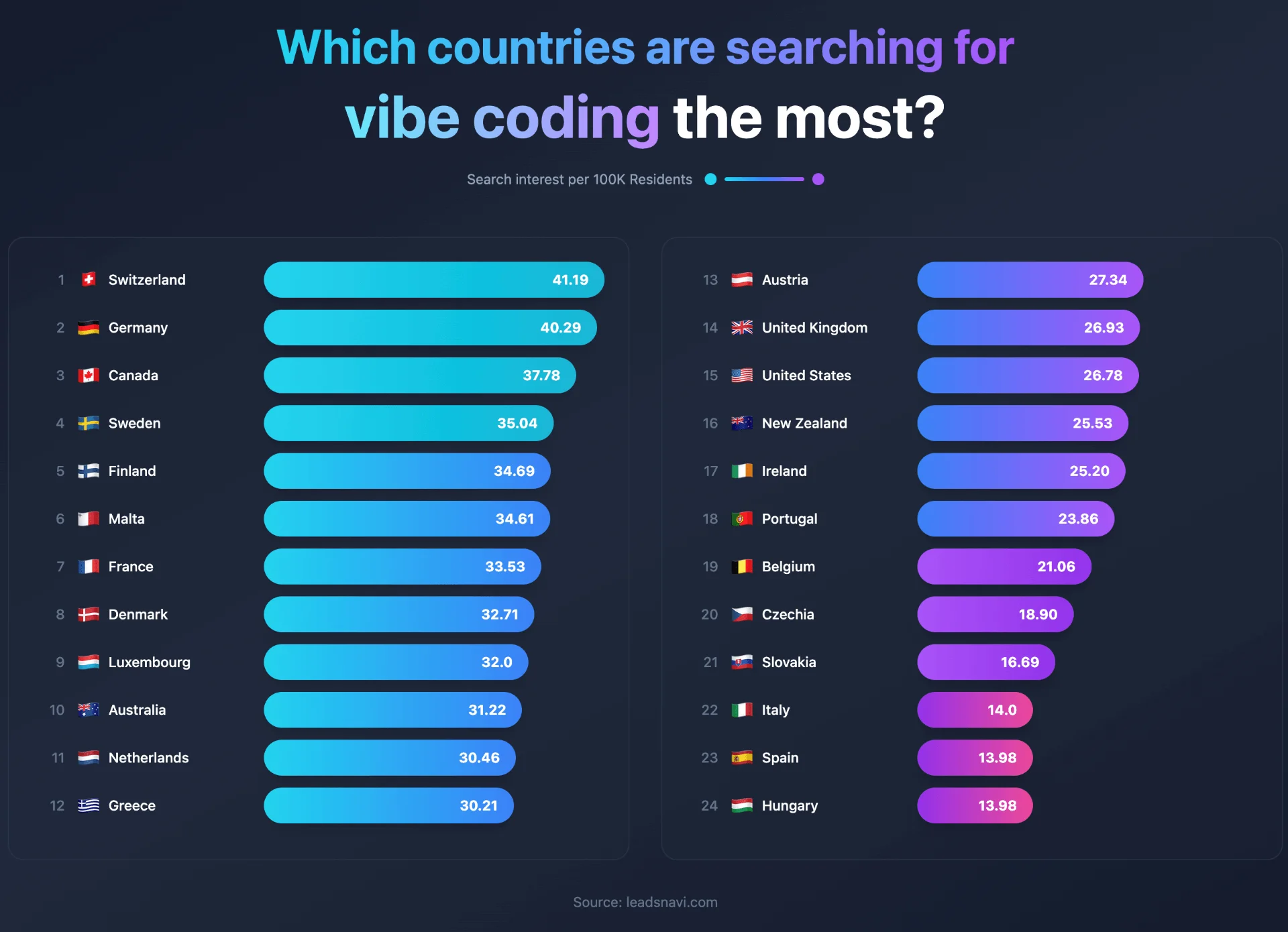
Image by LeadsNavi
To identify which countries are searching for “vibe coding” most, the study analyzed Google search data for “vibe coding” and related queries. The study combined total annual search volumes with population data to calculate searches per 100,000 residents.
Countries were ranked based on per-capita search intensity, with total search volume included for context.
The post Where on Earth is vibe coding taking off the most? appeared first on The New Stack.